[Excerpt]
“To be sacrificed on the altar. To hear the crowd gasp at the last flicker of my life. To honour Artemis. To be the stuff of legends. To be poetry. And not marry the old Admiral Hermocrates.”
That is my answer to my younger sister’s question—If Artemis, our gracious and divine protector, were to grant you one wish, what would it be?
Zosia loves to argue. “That’s more than one wish. Hermocrates was a Syracusan war hero, and he owns a fleet of ships. Take my advice. Marry him! You’ll have more slaves than Father and he’ll buy you the best silks and jewels, not just from here in Sicily, but from Athens.”
“I don’t care what I wear.”
“He’s old. He won’t try to give you babies. Aleta, his tool is rusty.” Let her tell her tool jokes now. She had her moon time twice and will marry in the Winter.
I’d never seen Hermocrates. Pretending to work at my loom, I listened through the wall to Hermocrates and my father arguing about the war and plays about the war. They lived for the Dionysian Festival in Athens. I had never seen a play. Women didn’t go. Listening to Father and Hermocrates debate theatre, I learned what I was missing. Men played all the acting and chorus roles—men and women characters. Women sometimes played in the orchestra. Enslaved women danced nude in pageants before the plays.
My father loved Euripides who he said was the greatest playwright of all time. I read Homer’s Iliad and Odyssey and knew about the Trojan Wars just like Euripides.
Father has a business meeting with an actor named Phadros. His voice shakes the house. Hermocrates is visiting too, as is his habit after a voyage from Athens. They are arguing. Hermocrates, being a former Admiral, is enraged that Euripides’ women mock brave warriors. To him, Euripides was a weakling incapable of wielding a sword. Phadros takes my father’s side and defends Euripides. We hear a loud crash on the other side of the wall. Zosia and I jump away from our looms. Good excuse for a weft mistake. I’m certain it was my betrothed, Hermocrates, who tipped the table over. Our slaves set everything back and are sent out of the room.
Then the men whisper about secret business deals. They don’t want my mother to hear.
The next day walking to Artemis’ Temple with Mother and Zosia, I carry a basket of my dolls which I should have given up before last summer’s She-bear ceremony. It marked me as a potential bearer of children. Polo and his son Patho, two of our slaves, follow behind us tugging two goats. One will be sacrificed in my honor.
On the shortcut to the Temple, Zosia dances like a puppet and sings, “Aphrodite, I love when you pull my strings, but I pray, Divine Grace, don’t yank my groom’s tool string on my wedding night.” She sings it over and over in a different voice each time. Mother can’t stop Zosia’s singing and dancing.
Mother quickens her pace and tries to drag us out of hearing distance of our slaves. They are our protection. I look back and see them struggle with the goats to keep up. It’s like the goats are resisting because they know their fate. Their resistance is a bad omen and Mother knows it.
Mother tries to stay composed. “Many girls have these little spells after their first moon time.” She doesn’t want Polo and Patho to hear Zosia. If word gets out, it will be impossible to find Zosia a match.
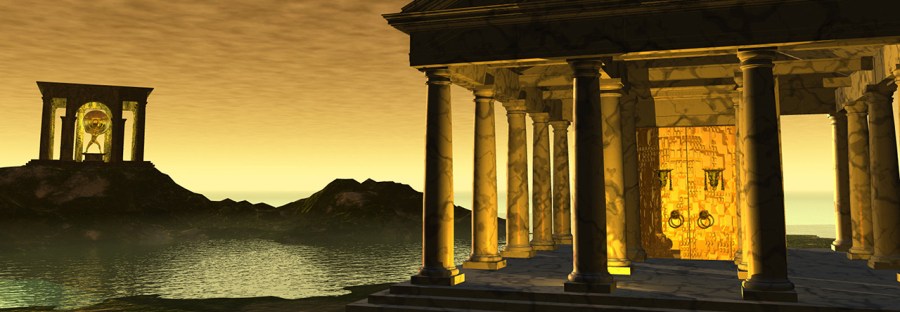
Men aren’t allowed in the Temple. Polo and Patho are afraid to even get close. Mother isn’t happy about having to drag the goats around to the rear of the Temple. Zosia and I lean against a pillar near the front.
From the path my mother followed, the froggy voice of one of her friends approaches and bends around the other side of the pillar. “She isn’t a beauty like her mother. It’s bad fortune for old Hermocrates.”
“Looking through his cataracts, her thick eyebrows and that chin, like a block of stone, won’t be too off-putting.”
They laugh, not noticing us as they enter the Temple. The other woman is the assistant priestess. My stomach tightens into a knot when I can’t remember the last time Father called me his little Aphrodite.
At first, I don’t follow my mother and sister into the Temple. My mother’s glare is like a flame. I wish I were the goat when I watch the assistant priestess slit its throat.
****
My dozing Mother and Zosia do not stir when a rock shoots out from the wagon wheel and strikes the underside of our wagon’s quilted and cushioned compartment. We are bound for the Sicilian coast and my wedding ceremony. Beeswax covered cheeses swing from the ceiling. Sweat drips down the insides of my arms. I regret not crawling out of my loft window during my last night home, crossing the stream and never returning.
I twist my head through the small side window in the wagon and squint through the brightness at Father. He sits tall on his white horse, an unusual grin carved into his usual stony face. Paris, my younger brother, turns on his brown mare and meets my eyes.
Paris’ expression says, “I have this horse, Aleta. What do you have?” I have the knowledge that my old groom’s fleet of ships set to transport fathers’ olive oil to the far reaches of the sea would make them both richer.
Mother snores. I shift a woolen clothing bag, a cushion for the beehive in my head. My brother’s embroidered and filigreed cloak and chiton is secured in the bag until my wedding day. I empty his fine cotton and silks on the wagon floorboard, throw off my gown, wrap into his chiton, secure his belt, swing his cloak over my head and tie it at the shoulder. I’ll keep my head scarf on for now. Stepping over my sister and mother, I move to the rear cargo exit of the wagon. Its door opens out and was built to fit a large earthenware jug of olive oil. I listen to wood, leather, and rope creak and strain as the horse team drags the wagon uphill. Father curses the man who sold him the horses.
Rolled into a ball like an olive oil jug, I wait by the rear exit for the perfect moment to escape, perhaps when the hill’s steepness stalls our climb. My heart batters my sternum. I picture the goddess, Athena watching, urging me to change back into my own clothes, to give up this rash scheme.
Mother rolls over and whispers in her dream. “Beautiful bride.”
In an instant, the wagon lurches backwards, then forwards, hurling me out of the cargo exit. Still curled into a ball, I roll down the dusty road towards Agyrium and into a hedge of sage. Lying on my back, looking up at the sage leaves, I wait for the horses and wagon to round the uphill bend. I listen for a sign—Moirai, whispering in the wind. But instead, I hear the horses snorting and gasping for breath, Father yelling and cracking the whip, the slaves grunting the wagon forward, and the sounds of that life fading away.
I stand and look at the dust on my brother’s fine wedding clothes—only one snag in the chiton. Perhaps no one will guess I am dressed for a wedding, even though the delicate filigree cloak’s border shows off nimble slave fingers.
There is a distant scream. I run down the hill. “Oh Mama, forgive me. Artemis, bless Mama with a child who might be clay in her hands.”
Galloping horses send me off the path. My father and brother. I slip between two boulders and find a narrow path switching back and forth down a steep canyon. Far down the rocky trail, I find two dried figs. A sign, at last. From Aphrodite—Goddess of Love— beckoning me forward. I knot the figs into a corner of my chiton.
I descend. The sparse vegetation gives way to a tangle of trees and bushes. Above, the sounds of galloping are moving up the road, below, the sound of the rushing stream. Voices near the stream. Men laughing and shouting. On the path I find twelve figs and then a few more, all of which I store in Paris’ chiton.
I veer off the path and continue through the tangle of shrubbery, searching for a vantage point to view the stream below. A woman screams, drowning the men’s laughter. I kneel behind a cypress stump. Below I see a basket of figs tilted against a rock. A muscled arm reaches for a fig. Shifting my body to one side, I see the edge of the stream. Several foot-soldiers’ bronze breastplates lean against each other. What army is this? I was never told of a war.
A scream from another voice. The first woman hurls curses. Another shrill scream, and then silence. I need to pee badly, but if I can hear their sounds, they’ll hear mine. I wait. Still kneeling, I squeeze my thighs together, rest my head on the stump, and strain not to pee.
The soldiers’ voices approach. I don’t breathe. They are climbing up to the road. From a strange dialect I decipher, “Poor Jason, didn’t get to dip his wick.” The sing-song Attic dialect is similar to that of two of our kitchen slaves.
“That’s his problem. If he was afraid of a little fight, he could have had her dead. She was still warm, wet, and snug. I felt it.”
“You put your finger in a dead woman?”
“Fingers. For good luck, I had to stir my comrades’ juices together with mine.” They laugh.
“Pass the figs back here… Jason. Figs.”
“I feel someone is watching.”
This accent is different from the others. Definitely not Attic.
The one called Jason continues, “We should wait until dark to make it back to our ship. Spartans will be waiting for us on the road. Listen.”
The sound of footsteps stops. I need to breathe.
Jason speaks again. “Did you hear that rustle off the path?” It’s quiet for a while. “We should look.”
The pressure in my bladder is torture.
It’s the Attic one again. “Jason, the sound of single flap of a butterfly wing scares you. That’s why you never get promoted.”
“Bakchos, you’ll surely get promoted for offing those helpless girls.”
“You better run. After I remove my sandal from your ass, I’m reporting you for cowardice.”
“Bakchos, forget about Jason. Save your strength for the Spartans. I wager they’re regrouping for another attack near our ships.”
Even before the voices up the hill completely fade, before I can properly squat, my leak turns to a gush. I watch the liquid find its own way down the hill. On the uneven ground, my little river takes a sudden turn—a sign from Moirai of a change of fortune.
I twist through a tangle of fallen trees and vines and step into the cool mist hovering near the stream. I try not to stare at the dead woman’s eyes or at the girl’s twisted mouth. I try not to look at their clothes torn open, their splayed limbs, their wounds. The dead girl’s stare. I don’t cry. I don’t scream, as I did only yesterday when Mother forced me into the wagon. The soothing childhood tales, the cocoon of family, the luxuries of the elite, the lie of superior lineage are vapour in the wind. I am alone.
The basket of figs is gone. A woolen blanket snagged on a tree branch would be useful. My slippers, made for short walks from the house to the carriage, are ripping. I crouch near the body and try not to touch the woman’s skin. I remove one sandal.
I tug at the second sandal held to the lifeless foot by the woman’s clenched toes. The sandal pops off tipping me off balance. I catch myself with my hand on the woman’s thigh. I tremble to my core. A single spot of blood in the shape of a face stains the sandal. I try to wash away the stain in the stream.
On a rock across the main flow of water, a shiny object bobs above the ripples. I wade through the thigh deep stream and find a knife, wielded perhaps by the slain woman in her attempt to fight the battle-tempered brutes.
Standing in the centre of the rushing stream, my legs clenched, my toes gripping the sandy bottom, I remove my head scarf and unravel my waist-length hair from the hairpins. I toss my head forward and back spreading my hair in the air. In one final release, I bend forward and slowly exhale. Just below the surface, my long locks dance and sway like they’re struggling to swim downstream. I unfold and fill myself with the deepest breath of my life. In one hand, I clump my hair not far from my scalp, and with the knife I cut the wet hair. The knife is sharp and slices through without effort. I release the hair in the water. Like an eel, it rushes downstream in the current. I kneel in the stream, curve into a ball, and hold my breath under the water for a long time. I stand and take in the world through a long, slow breath. In that instant while submerged the light had changed. Trees and rocks have hazy outlines.
I secure the cooking knife in my brother’s gazelle skin belt and follow the stream down the mountain. I want to rest and try to stop but a hundred varieties of fly stings make it impossible to even slow my pace. I adjust my headscarf to cover most of my face and forehead. I wave the blanket over my head to battle the clouds of insects. The bites on my eyelids are swelling, making it difficult to see. I pause above a waterfall, about twice my height. Here the breeze rescues me from the buzz of insects. I’m drenched with sweat. My brother’s chiton clings to my back and chest.
I wedge the tips of my sandals into cervices to climb down the canyon walls. Descending near a second waterfall, my sandal brushes against a wasp nest. The wasps swarm, circling my head, flying under my clothes. I wave the blanket at the wasps, lose my footing, and fall to the rocks below. Under my chiton the wasps sting. I throw off my clothes and plunge into a pool of water near the bottom of the waterfall. The cool water soothes the stings and the bruise on my shoulder.
I pluck the dead wasps from my clothes. A late afternoon wind sweeps through the canyon hushing the insect buzz. I wave my damp head scarf in the wind and wrap my chest flattening my small breasts. I dress in the chiton. In the dimming light and lacking a trail, I carefully pick my way over the smooth rocks in and around the stream. Like a mountain lion on hands and feet, I edge forward on an endless slippery rock shelf winding down the mountain. The canyon narrows.
From a flat rock the size of my mattress, I look down from the top of a waterfall. Since the canyon wall is too steep to descend in the dark, I curl up in the blanket on the ledge and listen to the roar of the waterfall. My chiton is damp. I shiver in the cold night. The chattering of my teeth starts and stops in the rhythm of waves brushing the distant shore. There, in the marriage bed, I would have agonized under wrinkled skin, sour sweat, and the thrusts of a strange husband. I would have suffered the absence of my parents as I do now.
The roar of the waterfall is constant and yet after listening for a long time, I hear in that constancy—variety in the sound of the water. Constancy is not perfect. The inconstant sound of the waterfall is a message. Change is best. The waterfall tells me there is no path back to my old life and the mask of a dutiful daughter.
In the morning, I eat all but two of my remaining figs. I descend the steep cliff next to the waterfall, taking care with each step. No wasps. The stream widens and flattens. By mid-day, I cross several paths leading down to the large pools and caves carved into the canyon walls. Piles of ashes and a shattered water jug tell me people visit this place.
I hear chanting. Singing. I move away from the creek and hide in a strip of cypress trees. The chant echoes from a nearby cave. Crude pillars frame the cave entrance. The smiling stone goddesses on the top of each pillar focus their welcoming gaze on me. I creep towards the mouth of the cave and peer inside.
Glowing embers light an old woman lying on a platform. It’s built with twisted pieces of driftwood overlayed with twigs and brown sheepskins. I take two steps forward and stop.
“Bion! Does your husband know you came? I loved the rosemary lamb… Bion?”
“I’m not Bion.”
“Welcome. Please. Welcome. Do you have any food? I can’t move very well. Please bring it here. My name is Peladora. I don’t know your voice, so you are here for the first time?”
“Yes.” I unfold my last two figs from the corner of my tunic and place them in Peladora’s hand.
Peladora’s eyes, like quartz, admit no light. Peladora holds one fig in each hand and tilts her head up to the goddesses above. The pink glow in her eyes brightens. A beautiful chant echoes through the cave—from the old woman, but also from many voices. Waves of vibrations leap over each other, creating a sea of sound transporting my heart and soul to a new body in a new world. The voices soar to a crescendo, then gradually calm down.
Peladora smiles and takes a tiny bite out of one of the figs. “Oh, bless you! This is delicious. Are you pregnant, my dear?”
“No. How could I be?”
“I wish I had one of these figs for every time someone asked me: ‘How could I be?’ This is the best tasting fig I’ve ever eaten. I hope you don’t mind if I eat slowly. I spent much of life here helping with births. Lessening pain. Caring for some abandoned by their families. Some without husbands. Some with husbands away at war. I shouldn’t say I help women birth. It’s not me. Eileithyia, goddess of childbirth, breathes her power through me. I’m a dry river canyon. Eileithyia is the soothing water between the canyon walls. The singing you heard—that was Eileithyia’s voice. I sing along. Little more than mouthing the words. I already forgot your name.”
Without hesitation, I borrow my brother’s name. “Paris.”
“Seducer of Helen of Troy. I would have remembered Paris. Helen’s seductress, I might believe. Fine. If you wish to say your name is Paris, I will call you Paris. Bion didn’t come. I need you to help me for a few days until she comes. I have no food, so you can learn about fasting. I can learn about fasting because I’m terrible at it. You should teach me how to fast. Then, I can teach you to channel the voices of the gods and goddesses. Paris”—Peladora leans towards me and lowers her pitch— “I could help you speak with the voice of a man. You’ll stay?”
“Yes.”
“You’re smiling. I know. I’ve heard you utter only a handful of words, but I hear you do have a strong voice. Very strong. You’ll make a fine, young man. I can hear you talking to your mother with that voice. Poor woman. Are you going to deny the grief you gave your mother?”
“No.”
“Just think about how hard your mother had to strain to push you into the world. I teach mothers in labour to use the energy of their voice to help them through the pain. To give them strength to push babies out. Really, Eileithyia teaches them through me. It’s not all that simple. We have herbs and poultices too. Do you have more figs? Just one would fill me up.”
“No.”
*****
I stay until the full moon, and until another full moon and a few more days. During that time, I witness Peladora channel the voices of many goddesses, and gods too. I sing with her in the morning and evening. I pick berries, gather firewood, and use Peladora’s net to catch tiny fish. With figs from a tree near the main road, I feed us for many days.
One afternoon, I am putting melody to a Sappho poem I learned as a little girl.
Listen, you luscious, long-haired Graces, and Muses.
I cut my hair.
So now, to eternity
You’ll remember me.
Forgetting the words, I continue the tune improvising new lyrics.
Midwife of the inner sanctum.
Sitting on her sacred bottom,
Pulls an infant from a crack.
He’s so ugly, put him back—
On the last line, Peladora falls off her platform laughing. A woman walks in, breastfeeding an infant. Her eye is swollen shut, and there’s blood on her chiton. Peladora is silent.
The woman, mouth agape, eyes adjusting to the dimness of the cave, stares at me.
Peladora smiles. “Bion?”
“Yes.”
Bion’s three-year-old walks in, pulling a lamb by a hemp rope and her five-year-old drags a goat. The three-year-old, her face level with Peladora’s, slowly advances towards the old woman and gazes into her quartz eyes. In the silence, I watch Bion anticipate her daughter’s reaction—the mother’s heart bound to the child’s as if the cord was never cut.
The power of this mother’s contemplation unveils an emptiness in my chest. My mother abandoned me to others. The cord was cut too soon. My heart echoes in the overwhelming void of the cave.
The little child leans forward ever so slightly and kisses one of the old woman’s eyes, pulls back smiling, and kisses her other eye. A single tear journeys down the life etched into Peladora’s face.
“Bion, this is Paris. Paris’s been keeping me alive.”
Her eyes widening, Bion’s attention shifts from her children to me. “A male profaning our holy temple. Mocking the rite of birth. ‘Pulls an infant from a crack. Put him back.’ Is that not defiling?”
The children, fearful of their mother’s sharp tone of voice, begin crying. The goat bleats, amplifying the dissonant echoes in the cave.
Peladora motions to me. “Take the children outside and milk the goat.”
I whisper, “But I never milked—
“You’ll find the udders on the underside of the goat. Take the clay bowl near the fire pit. And rinse it in the stream first. The large bowl. You’ll need it. From the sound of that goat, she’s ready to burst. And don’t leave any milk in her udder.”
While I milk the goat, the older girl runs out of the stream holding a small branch. Woven through the twigs is a thick clump of long dark hair. The girl waves the branch around my head as I coax the milk from the udder.
 David Secunda